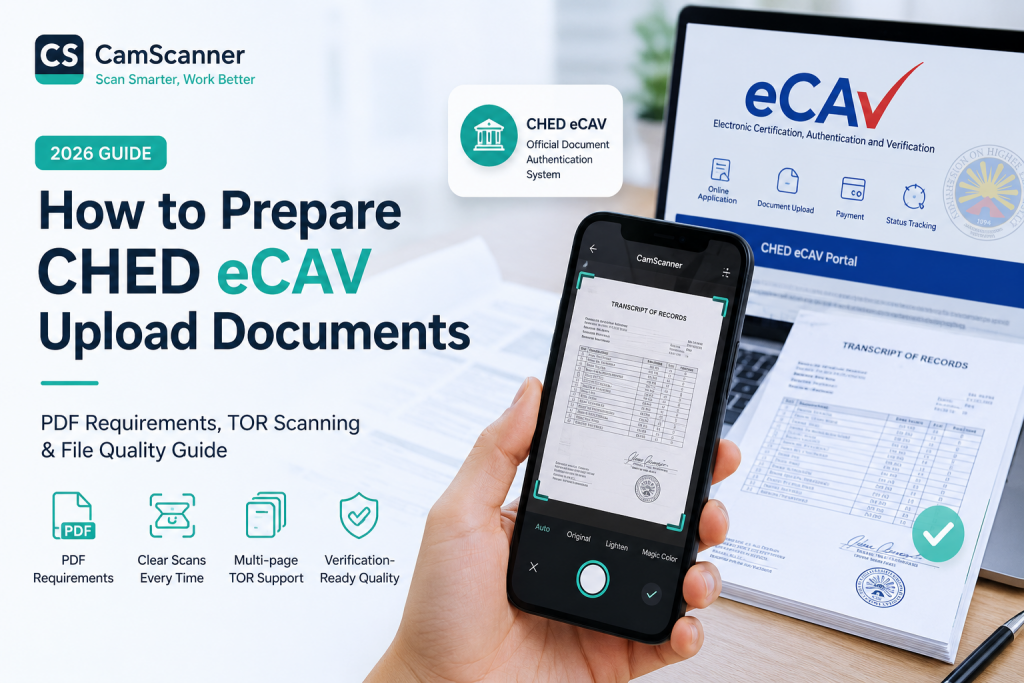
If you’re applying through the CHED eCAV (Electronic Certification, Authentication and Verification) system, your academic documents should generally be uploaded as clear PDF scans rather than ordinary phone photos.
For documents such as Transcript of Records (TOR), Diploma, and Certificates, applicants should ensure:
- PDF format
- Complete page edges
- Readable text, signatures, and official seals
- Correct page order for multi-page files
- High-quality scans suitable for document verification
CamScanner helps applicants create upload-ready PDF documents by combining pages, correcting perspective, improving readability, and checking file quality before submission.
What Is CHED eCAV and Why Do PDF Scans Matter?
CHED eCAV (Electronic Certification, Authentication and Verification) is CHED’s online document authentication system used for verifying higher education records in the Philippines. Applicants commonly upload documents such as Transcript of Records (TOR), Diploma, Certificates, and other academic documents for review and verification.
One of the most common reasons for delays is not the application itself, but the document upload quality. Files that are blurry, incomplete, incorrectly ordered, or not uploaded in the required format may be marked for correction or resubmission, extending the processing timeline.
This guide focuses on three practical questions:
- When should you prepare your CHED eCAV documents?
- Why are clear PDF scans preferred over casual phone photos?
- How can CamScanner help you create upload-ready PDF files with better quality control?
What Does CHED eCAV Check During Document Verification?
During CHED eCAV document verification, reviewers generally focus on whether uploaded files are clear, complete, readable, and suitable for authentication, not simply whether a file exists.
Typical checks include:
- Names, school information, degree/program, and dates are readable.
- Page edges, signatures, seals, and page numbers are not cut off.
- Multi-page documents such as TOR are uploaded in the correct order.
- The file format complies with the upload requirements, commonly PDF.
This is why a quick phone photo is often insufficient. Glare, shadows, perspective distortion, poor focus, and compression can make important details difficult to verify.
When Should You Prepare Your CHED eCAV Documents?
To reduce the risk of missing correction windows, many applicants prepare their CHED eCAV upload documents in stages:
1–2 weeks before submission
- Confirm required document types with your school or Registrar.
- Check whether certified copies, signatures, or official seals are required.
1–3 days before submission
- Scan documents.
- Merge pages into PDF files.
- Perform a final quality check (QC).
- Prepare a folder of files that are ready to upload.
After submission
- Monitor your CHED eCAV account and notifications.
- If corrections or additional uploads are requested, follow the instructions within the specified window shown in your account.
Submitting clear PDF scans correctly the first time can significantly reduce the chance of entering a resubmission cycle.
Why Does CHED eCAV Prefer PDF Scans Over Phone Photos?
Why PDF?
- Stable formatting for review and printing.
- Easy handling of multi-page TOR files.
- More standardized for document upload and archiving.
Why Scans Instead of Casual Photos?
Many applicants ask whether simply converting a photo into PDF is enough.
In practice, a PDF created from a blurry photo does not automatically become a compliant scan. Reviewers still need to verify names, dates, signatures, seals, and page completeness. Common problems include:
- Glare covering stamps or signatures.
- Shadows across the document.
- Perspective distortion.
- Missing page edges.
- Unreadable small text after zooming.
How CamScanner Helps Prepare CHED eCAV Upload Documents
CamScanner is not part of CHED or the eCAV system. Instead, it helps applicants prepare upload-ready PDF documents before submission.
PDF Export
Export scanned pages directly as PDF files.
Automatic Cropping & Manual Adjustment
Reduce the risk of cutting off page numbers, seals, or signatures.
Perspective & Rotation Correction
Straighten tilted pages and normalize page orientation.
Readability Enhancement
Improve visibility of small text and light seals without excessive editing.
Multi-Page Management
Combine multiple TOR pages into one PDF and check page order before export.
How to Scan Documents for CHED eCAV Using CamScanner
Step 1: Prepare Your Documents
- Place documents on a flat surface.
- Use even lighting.
- Avoid strong reflections on laminated certificates.
- Keep the camera parallel to the page.
Step 2: Scan Every Page
- Scan each page individually.
- Keep all four edges visible.
- Rescan pages with faint stamps or signatures if necessary.
Step 3: Check Page Borders
- Ensure cropping includes the entire document.
- Do not cut off page numbers or seal edges.
- Straighten tilted pages.
Step 4: Merge TOR into One PDF
- Combine all Transcript of Records (TOR) pages into a single PDF unless the system requests separate files.
- Verify that no pages are missing, duplicated, or out of order.
Step 5: Review Before Uploading to CHED eCAV
Zoom to 150%–200% and check:
- Name
- School name
- Degree or program
- Dates
- Signatures
- Official seals
- Complete page edges
CHED eCAV PDF Upload Checklist
Before uploading your documents, confirm that:
File is saved as PDF.
Every page is completely visible.
Names and student information are readable.
Signatures and official seals are clear.
TOR pages are in the correct order.
No pages are missing.
The PDF opens correctly before upload.
When Should You Rescan a Document?
Small text becomes blurry when zoomed
Risk: information may not be verifiable. Solution: rescan with better focus and lighting.
Glare covers a stamp or signature
Risk: key verification details are hidden. Solution: adjust the angle and rescan.
Page edges are cut off
Risk: document appears incomplete. Solution: redo the crop and export again.
TOR pages are out of order or missing
Risk: a common reason for correction requests. Solution: reorder pages and merge again.
File is not in PDF format
Risk: upload may not meet the required format. Solution: export as PDF using CamScanner.
FAQ
- Can I upload JPG instead of PDF?
Follow the format specified by the CHED eCAV upload system. If PDF is required, export your academic documents as properly scanned PDF files.
- Can I take photos instead of scanning?
Phone photos may suffer from glare, shadows, distortion, or missing edges. A proper document scan generally provides more consistent readability for document verification.
- How should I scan my Transcript of Records (TOR)?
Scan every page clearly, keep the correct page order, merge pages into one PDF when appropriate, and review the entire file before uploading.
- What is the fastest way to fix a correction request?
Identify the specific problem page, rescan only that page, replace it in the PDF, and upload the corrected version with a clear file name.
Key Takeaways
When preparing documents for CHED eCAV, remember these essentials:
- Use PDF whenever required by the upload system.
- Scan documents instead of relying on casual phone photos.
- Make sure TOR, Diplomas, and Certificates are complete and readable.
- Check signatures, official seals, page borders, and page order before uploading.
- Use CamScanner to organize, merge, and review documents before submission to reduce the likelihood of resubmission due to document quality issues.
References
This guide is intended to help applicants prepare high-quality digital documents for CHED eCAV (Electronic Certification, Authentication and Verification) submissions. It is based on publicly available information from the official CHED eCAV website. Applicants should always refer to the latest official requirements, application instructions, and account notifications before submitting documents.
Official guidance on required documents, accepted file formats, and submission requirements for Graduate, Medical Allied, and Undergraduate (Unit Earner) applicants.
Official answers to common questions about document submission, application processing, correction requests, payments, and other eCAV procedures.